
Lifecycle automation is becoming a defining requirement for modern telecom operators. Yet the term is often misunderstood.
Some see it as another automation trend. Others associate it with AI-driven systems that promise more than they deliver. In practice, lifecycle automation is far more grounded and far more operational.
Lifecycle automation is about how work moves from first intent to live service and revenue without fragmentation.
The telecom service lifecycle already exists
It is just disconnected.
Every telecom operator runs on a lifecycle whether it is formally designed or not.
- Service qualification
- Order creation
- Network provisioning
- Field execution
- Service activation
- Billing and assurance
- Support and change
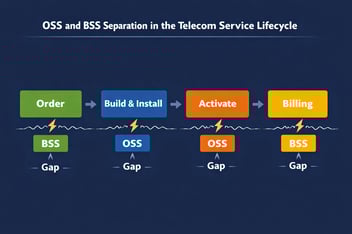
The challenge is not defining these stages. The challenge is that each stage lives in different systems owned by different teams.
- OSS tracks the network.
- BSS tracks the customer and revenue.
- Field systems track work execution.
- Finance reconciles outcomes later.
Lifecycle automation connects these stages so that data flows forward naturally instead of being manually rebuilt at every step.
This is the foundation of the AEX One platform, where OSS and BSS are treated as a single operational lifecycle rather than separate domains.
Automation is not about removing people
It is about removing uncertainty.
Lifecycle automation does not eliminate human decision making. It removes ambiguity.
Instead of teams asking:
- Has this order been qualified
- Is this site actually ready
- Did the field work complete correctly
- Can billing safely proceed
The system already knows.
Automation ensures that when one stage completes, the next stage has verified context. That context is what prevents delays, rework, and revenue leakage.
Where lifecycle automation delivers the most value
Not every process needs intelligence. The biggest gains come from the transitions between systems.
- Service qualification and feasibility
Rules are applied consistently across sales and operations so feasibility is not re evaluated downstream. - Order orchestration across OSS and BSS
Orders advance because dependencies are met, not because someone manually intervened. - Field execution alignment
Work orders reflect real network and service context so crews arrive prepared. - Activation and service closeout
Completion data flows directly into customer and billing records without reconciliation. - Revenue assurance
Billing reflects what was actually delivered in the field and on the network.
These transitions are where most operational risk accumulates. Lifecycle automation focuses here first.
Execution data is what makes these transitions reliable. When field outcomes become trusted lifecycle input, systems gain a system of record for what was actually delivered, not what was planned
One of the reasons these transitions carry so much risk is the continued separation of OSS and BSS across the service lifecycle, which quietly introduces delays, inconsistencies, and downstream reconciliation work.
Why many automation efforts fail
Automation often fails when it is applied inside silos.
Automating a single OSS workflow or billing rule can improve local efficiency while increasing system wide confusion. Without shared lifecycle context, automation accelerates fragmentation.
True lifecycle automation requires a unified operational model across OSS and BSS.
TM Forum has long emphasized end-to-end service lifecycle management as critical to digital operations maturity in telecom. The focus is on aligning OSS and BSS around shared lifecycle stages rather than optimizing separate domains.
Siloed Automation vs Lifecycle Automation
| Aspect | Siloed Automation | Lifecycle Automation |
|---|---|---|
| Approach | Automates tasks within individual systems | Automates transitions between lifecycle stages |
| Focus | Local efficiency improvements | End-to-end operational continuity |
| System Impact | Accelerates fragmentation across silos | Unifies OSS and BSS into single operational flow |
| Data Flow | Manually rebuilt at every handoff | Context flows forward automatically |
| Outcomes | Faster silos, slower overall delivery | Predictable execution from order to revenue |
| Risk Handling | Problems surface late, after customer impact | Issues detected at transitions before escalation |
| Scalability | Operational drag increases with growth | Growth becomes controlled and predictable |
Lifecycle automation does not require replacing everything
A common misconception is that lifecycle automation demands a full system replacement.
In reality, successful operators approach it incrementally:
- Define lifecycle stages clearly
- Align system ownership to each stage
- Automate transitions before automating tasks
- Introduce intelligence only where data quality is trusted
This approach reduces operational risk and supports modernization without disrupting live services.
This is why AEX One is positioned as a lifecycle platform, not a collection of tools. It enables operators to modernize execution while preserving what already works.
You can explore how this lifecycle approach is structured here.
What changes once lifecycle automation is in place
The operational shift is immediate.
- Executives gain real time visibility instead of reconciled reports.
- Operations teams trust system status instead of chasing updates.
- Field teams operate with confidence instead of assumptions.
- Finance closes faster with fewer adjustments.
Most importantly, growth becomes predictable.
Lifecycle automation transforms scale from a risk into a controlled outcome.
For operators looking to implement lifecycle automation, the path from customer interest through installation to invoicing represents the highest-impact opportunity. Our guide on closing the gaps from interest to install to invoice walks through how lifecycle automation eliminates friction at each critical handoff.
Why lifecycle automation matters now
Telecom operations are under pressure from expansion, funding accountability, and rising customer expectations. The operators that scale successfully are not simply working faster. They are working with greater operational certainty.
Gartner research shows that operators who fail to modernize operational integration struggle to scale digital services reliably as complexity increases. The challenge is not individual system performance—it's the inability to maintain visibility and control across the service lifecycle as volume grows.
Source: Gartner – Market Guide for CSP OSS and BSS Platforms
Lifecycle automation is not about speed alone. It is about control across growth.
When OSS and BSS operate as separate domains, scale introduces coordination overhead, delayed visibility, and persistent reconciliation work. When they operate as a unified lifecycle, scale becomes predictable. Orders advance with verified context. Field execution aligns with network reality. Billing reflects completed work.
The operators that adopt lifecycle automation early gain a compounding advantage. Those that delay it manage exceptions until the cost becomes structural.
Frequently Asked Questions
What is lifecycle automation in telecom
Lifecycle automation connects OSS and BSS processes so service delivery flows end to end without manual handoffs or reconciliation. The same execution challenges appear in other asset intensive industries, including oil and gas, where field metrics increasingly define operational maturity.
How is lifecycle automation different from workflow automation
Workflow automation optimizes tasks inside a system. Lifecycle automation ensures continuity across systems and teams.
Does lifecycle automation require replacing OSS and BSS
No. It can be implemented incrementally by standardizing stages and automating transitions first.
Why is OSS and BSS unification important
Separated systems create blind spots between network execution and revenue realization.
What is the first step in implementing lifecycle automation
The first step is to clearly define your lifecycle stages and identify the highest-risk transitions—typically from qualification to order, order to execution, and execution to billing. Start by automating validation at these handoff points before attempting to automate tasks within systems.
How does lifecycle automation reduce revenue leakage
Lifecycle automation ensures that billing reflects what was actually delivered in the field and on the network. By eliminating delays between service completion and revenue recognition, operators reduce the gap where installations outpace closeouts and revenue becomes unpredictable.