
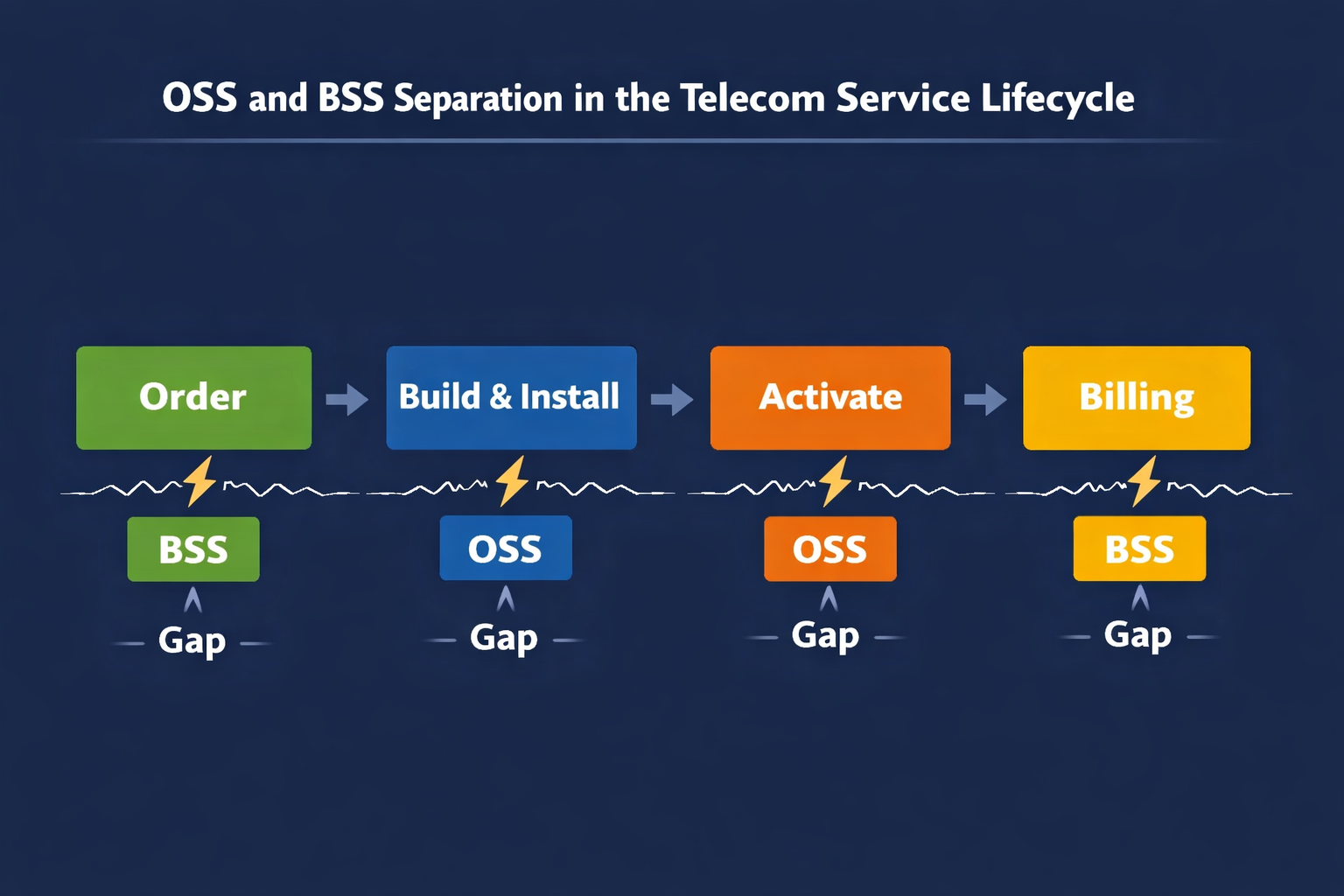
When interest, install, and invoice operate as disconnected stages, OSS and BSS separation becomes a structural execution risk rather than a technical choice.
Telecom operators rarely decide to separate OSS and BSS. It usually happens gradually.
- A billing system is added to support growth.
- A network tool is layered in to improve visibility.
- A field platform is introduced to help crews move faster.
Each decision makes sense in isolation. The risk appears later, in the spaces between systems.
Those gaps are not always obvious day to day. But over time, they quietly shape delays, revenue leakage, and customer frustration as operations scale across the service lifecycle.
OSS and BSS were never meant to operate in isolation
- OSS manages network and service state.
- BSS manages customers, orders, and revenue.
In theory, these domains are complementary. In practice, they are often run as separate worlds, owned by different teams, measured by different outcomes, and connected through brittle integrations.
When OSS and BSS operate independently, no single system understands the full service lifecycle. Each sees part of the truth. None see the whole.
That partial visibility is where invisible risk begins.
The risk does not show up where teams expect it
Most operators assume OSS BSS separation creates reporting problems or reconciliation work. Those are symptoms. The deeper risk appears earlier.
Orders move forward without verified readiness.
Field work completes without billing confidence.
Activations drift from what was actually delivered.
Exceptions become routine rather than rare.
Each issue alone feels manageable. Together, they create operational drag that grows faster than subscriber counts.
Execution data is often the missing layer in this breakdown. When field work completes but never becomes trusted lifecycle input, neither OSS nor BSS can act as a true system of record for what was actually delivered.
Why separation becomes more dangerous as operators grow
- At small scale, people bridge system gaps manually.
- At medium scale, teams create workarounds.
- At large scale, those workarounds collapse.
As volume increases:
- More orders move through the system simultaneously
- More contractors participate in delivery
- More services share infrastructure
- More revenue depends on accurate closeout
Separated OSS and BSS systems cannot reason across the lifecycle together. Growth exposes problems that did not exist at launch.
Separated OSS/BSS vs Unified Lifecycle Operations
| Aspect | Separated OSS/BSS | Unified Lifecycle Operations |
|---|---|---|
| Risk Visibility | Problems surface after they impact customers | Issues detected at handoff points before escalation |
| Order Progression | Orders move forward without verified readiness | Orders advance only when prerequisites are met |
| Field Completion | Field work completes without billing confidence | Field completion updates billing automatically |
| Service State | Each system has partial truth, none see the whole | Service state reflects what was actually delivered |
| Exception Handling | Exceptions become routine and multiply with scale | Exceptions decrease as volume increases |
| Revenue Certainty | Installations outpace closeouts, billing lags delivery | Revenue recognition aligns with completed work |
| Growth Pattern | Operational drag grows faster than subscriber counts | Growth becomes predictable rather than fragile |
The handoff problem no dashboard can fix
Many operators try to solve OSS BSS separation with better dashboards.
Dashboards show what already happened. They do not prevent breakdowns at handoff points.
The highest risk moments are not static states. They are transitions:
- From order to build
- From build to activation
- From activation to billing
These handoff failures are most visible when interest, install, and invoice do not operate as a single execution lifecycle.
Why integration alone is not enough
APIs help systems exchange data. They do not ensure systems agree.
Many OSS BSS stacks are integrated but not aligned. Data moves between tools, yet meaning is lost because each system applies its own rules and assumptions.
True alignment requires:
- Shared lifecycle stages
- Clear ownership at each stage
- Automated validation at transitions
- A consistent service record from interest through billing
Without alignment, integrations simply move inconsistencies faster.
Where invisible risk turns into real business impact
Leaders usually feel the impact before they can trace the cause.
- Revenue forecasts miss expectations.
- Installations outpace closeouts.
- Billing lags behind delivery.
- Customer confidence erodes quietly.
These risks are most visible in the path from interest to install to invoice, where small disconnects quickly turn into delayed revenue and customer frustration.
What changes when OSS and BSS operate as one lifecycle
When OSS and BSS are unified through lifecycle automation, several shifts happen quickly.
- Orders advance only when prerequisites are met.
- Field completion updates billing automatically.
- Service state reflects what was actually delivered.
- Exceptions decrease instead of multiplying with scale.
Most importantly, growth becomes predictable rather than fragile.
This does not require replacing every system. It requires rethinking how systems participate in the lifecycle together.
Why this matters now
Telecom operations are under pressure from expansion, funding accountability, and rising service expectations. Operators can no longer afford the invisible drag that OSS and BSS separation creates.
TM Forum continues to emphasize end-to-end service lifecycle alignment as a foundation for operational maturity in telecom operations. Operators that treat OSS and BSS as separate domains are increasingly forced to manage complexity manually.
The operators that succeed at scale are not necessarily the ones with the newest tools. They are the ones that unify their operational systems around a shared lifecycle—allowing orders, field execution, and billing to operate from the same source of truth.
Those that unify OSS and BSS reduce risk before it becomes visible. Those that wait manage exceptions until the cost becomes unsustainable.
Those that unify them reduce risk before it becomes visible.
Frequently Asked Question's
What is the difference between OSS and BSS in telecom
OSS manages network and service operations, while BSS manages customers, orders, and billing.
Why is OSS and BSS separation risky
Separation creates gaps at lifecycle handoffs where delays, errors, and revenue leakage accumulate.
Can OSS and BSS be unified without replacing systems
Yes. Many operators align lifecycle stages and automate transitions without full system replacement.
How does lifecycle automation reduce OSS BSS risk
It ensures each stage of service delivery inherits verified context from the previous stage.
How does OSS BSS separation affect revenue recognition
When OSS and BSS operate independently, completed field work often fails to trigger billing updates automatically. This creates delays between service delivery and revenue recognition, causing installations to outpace closeouts and making revenue forecasts unreliable.
What is the first step to reduce OSS BSS separation risk
The first step is to identify the highest-risk handoff points in your service lifecycle—typically from order to build, build to activation, and activation to billing. Automating validation at these transitions reduces errors before they cascade into customer-facing issues.