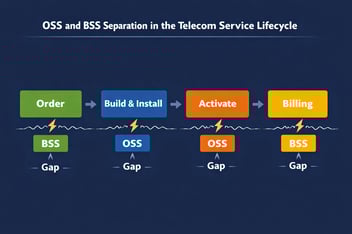

Execution problems rarely start at billing. They start much earlier, when work is completed in the field but never becomes trusted, connected data.
Crews finish installs. Assets are deployed. Service is activated. Yet leadership still lacks confidence in what actually happened, when it happened, and whether it can be billed accurately. This gap is not a reporting issue. It is an execution data issue.
When execution data sits outside core systems, every downstream function pays the price.
Why execution data is different
Execution data is created where work happens. In the field. On site. Under real world conditions.
It includes
• what work was completed
• when it was completed
• who completed it
• which assets were used
• what changed from the plan
This data is fundamentally different from planning data or billing data. It reflects reality, not intent.
When execution data remains trapped in disconnected tools, spreadsheets, or point solutions, it never becomes trusted enough to drive decisions. Instead, it is reconciled later, questioned endlessly, or ignored altogether. Over time, these gaps accumulate across the end to end service lifecycle.
What execution data looks like in practice
Execution data is not abstract. It is specific, timestamped, and verifiable.
In fiber broadband operations, execution data includes
- photo documentation of completed work with GPS coordinates
- material usage records tied to specific service orders
- test results showing signal strength and connectivity
- actual start and completion times versus scheduled times
- notes on site conditions or deviations from design
- crew assignments and skill validation
This level of detail does not exist in planning systems. It is created only when work happens.
When captured during execution rather than after the fact, this data becomes the most reliable source of operational truth. It reflects what the customer will experience, what assets were deployed, and what can be safely billed.
How execution gaps turn into revenue risk
When execution data does not flow cleanly into core systems, problems compound quietly.
Delays emerge because downstream teams wait for confirmation that work is complete.
Disputes increase because finance cannot reconcile what was delivered versus what was invoiced.
Revenue leaks because incomplete or unverified work never reaches billing at all.
These issues are amplified when OSS and BSS remain disconnected
The longer this gap persists, the harder it becomes to trace accountability. Leadership sees symptoms but not causes. Teams fix issues manually instead of structurally.
By the time customers feel the impact, the root problem is already buried.
The hidden cost of treating execution data as secondary
When execution data is treated as less important than planning or billing data, operational dysfunction follows a predictable pattern.
Field teams complete work but lack confidence their updates will be trusted. They stop providing detail because it is not acted upon.
Finance teams wait days or weeks for field confirmation before closing orders. Revenue recognition lags behind actual service delivery.
Operations teams build parallel tracking systems because core systems do not reflect field reality. Reconciliation becomes a permanent function rather than an exception process.
Field service research consistently shows that organizations with disconnected field data experience significantly longer order-to-cash cycles and higher rates of billing disputes. The gap between service delivery and revenue recognition often extends to weeks when execution data requires manual reconciliation.
Customer support inherits problems that originated in disconnected execution. Service appears active in billing systems but does not work in the real world.
These costs are rarely measured directly. They show up as longer cycle times, higher dispute rates, and persistent operational confusion. Leadership sees the symptoms but cannot trace them to the root cause because execution data never became visible enough to diagnose.
Why execution data must become the system of record
Organizations that treat execution data as the operational system of record behave differently.
Field completion triggers downstream processes automatically.
Billing confidence improves because work is verified at the source.
Leadership gains visibility without waiting for reports or reconciliations.
Most importantly, execution stops being a black box.
This shift does not require replacing every system. It requires recognizing execution data as the connective tissue between planning, operations, finance, and customer experience.
When execution becomes the system of record, teams stop debating what happened and start acting on what is happening.
Execution Data as Secondary Input vs System of Record
| Aspect | Execution Data as Secondary Input | Execution Data as System of Record |
|---|---|---|
| Trust Level | Questioned, reconciled, or ignored | Authoritative and triggers downstream processes |
| Capture Timing | Documented after work is completed | Captured during execution in real time |
| Downstream Processes | Wait for manual confirmation | Triggered automatically by verified completion |
| Visibility | Available through delayed reports | Available as work progresses |
| Accountability | Root causes buried in reconciliation | Clear source of truth for outcomes |
| Billing Confidence | Finance waits for field confirmation | Billing proceeds based on verified field data |
| Revenue Impact | Delays between delivery and recognition | Revenue aligns with completed work |
How execution data becomes trusted at scale
Making execution data the system of record is not about capturing more information. It is about making the right information available at the right time with the right level of trust.
This requires three operational shifts.
First, capture execution data during work rather than after completion. Mobile tools that allow crews to document progress, upload photos, and record materials in real time eliminate the gap between execution and visibility.
Second, validate execution data at the source before it triggers downstream processes. Automated checks ensure required fields are completed, photos meet quality standards, and test results fall within acceptable ranges. This prevents incomplete data from cascading into billing or customer communication.
Third, integrate execution data directly into OSS and BSS workflows. When field completion automatically updates network records, triggers billing, and notifies customer success, execution becomes operationally authoritative rather than informational.
Organizations that complete these shifts see immediate operational improvements. Billing cycles shorten. Disputes decline. Leadership gains real time visibility into what is actually happening across the service territory.
When execution data becomes the system of record, it completes the operational connection from customer interest through installation to accurate invoicing. Our guide on closing the gaps from interest to install to invoice shows how execution visibility eliminates friction across the entire service lifecycle.
The leadership shift this requires
This is not a technology decision alone. It is a leadership decision.
Treating execution data as secondary sends a clear message that field reality is negotiable. Treating it as the system of record signals that outcomes matter more than assumptions.
Execution data is not just operational input. It is the earliest signal of risk, revenue, and customer impact.
Organizations that recognize this see problems sooner, recover faster, and scale with confidence.
Frequently Asked Questions
What is execution data
Execution data captures what actually happens during field work, including completion status, timing, resources used, and deviations from plan.
Why is execution data important for revenue
Because incomplete or unverified execution data prevents accurate billing and increases disputes, delays and revenue leakage.
How is execution data different from operational data
Operational data reflects plans or system intent. Execution data reflects real world outcomes created in the field.
What does system of record mean in field operations
It means execution data is trusted, authoritative and triggers downstream processes without manual reconciliation.
Can execution data work with existing OSS and BSS systems
Yes. Execution data complements OSS and BSS by providing verified field reality rather than replacing them.