
There's a version of every operator's story where growth becomes the problem.
I don't mean growth slows down. I mean the systems, the processes, and the workflows you built when you were smaller start quietly failing at scale. It rarely announces itself. It just shows up as friction. A billing issue that didn't used to happen. A technician who can't get clear job information. A market you're trying to expand into that somehow takes three times longer to stand up than the last one.
I've watched this happen with operators across fiber and field service. The ones who scale cleanly have one thing in common. They build their operational infrastructure ahead of the growth, not in response to it.
This piece is about what that actually looks like in practice.
The breakpoint is predictable. Most operators just don't see it coming
When you're running a single-market operation with a team of 10 or 20, a lot of things work on informal trust. Your operations manager knows every technician personally. Your billing team knows which accounts need attention. Your provisioning process runs because the same three people have done it a thousand times and know exactly what to do when something goes wrong.
That stops working somewhere between 500 and 5,000 subscribers. Or between 10 and 50 technicians across multiple states. The informal knowledge that held things together doesn't travel. The systems you built for a smaller version of the business start generating errors, delays, and exceptions that your team now has to manually chase down every day.
For fiber operators, the breakpoints tend to cluster around the same places. Address data integrity degrades when you're managing multiple construction phases across multiple markets. Without a structured approach to GIS mapping and address classification, the serviceability data your sales team depends on becomes unreliable as the build scales. Provisioning lag grows when you're activating customers across different hardware vendors with no standardized workflow. Billing exceptions multiply when the handoff between field execution and your BSS isn't automated. And the customer experience starts to wobble at exactly the moment you're trying to use it as a competitive differentiator.
For field service and utility operators, the breakpoints look slightly different but the underlying problem is the same. The scheduling approach that worked when your dispatcher knew every technician doesn't hold up across regions. Segra, a multi-state fiber network provider, was running its entire field workforce through Outlook calendars before it hit that ceiling. Dozens of calendars, no central visibility, and a growing operation that the system simply could not keep up with. Field service optimization becomes harder to sustain when performance visibility drops and you no longer have eyes on the ground in every market. Consistent execution becomes hard to maintain when new contractor crews are being onboarded without a standardized system to train them to.
What operators who scale cleanly actually do
The difference between operators who hit the ceiling and operators who push through it isn't budget or headcount. It's the decisions they make about operational infrastructure before the pressure arrives. Here's what those decisions look like in practice.
Encode your processes before you scale your team. The operators who struggle at scale are the ones whose best practices live in people's heads rather than in the platform, and the operational lessons that surface most reliably during growth point to the same conclusion every time. When a new technician joins, they should be training to a system, not to a colleague. When a new market stands up, the workflow should be consistent with every other market, not recreated from scratch. Checklists, documentation requirements, approval steps, and provisioning sequences all need to live in the platform before the next wave of hiring begins.
Build your reporting layer before you need it. At scale, you cannot be present everywhere. What replaces your presence is data. Technician performance tracked job by job. Provisioning lag visible in real time. Billing exceptions surfaced automatically rather than discovered when a customer calls. The operators who manage distributed teams well have invested in the reporting layer as deliberately as they've invested in the field layer. A manage-by-exception model, where anomalies are surfaced automatically and teams focus on resolving them rather than manually tracking operations across every state, is only possible when that reporting infrastructure is in place.
Close the gap between your back office and your field operations before it compounds. This is where I see the most friction in fast-growing fiber operations. The OSS and BSS systems are solid. The field execution is solid. But the handoff between them is manual, which means every activation, every completed install, every billing trigger depends on someone remembering to do something. At 500 subscribers that's manageable. At 5,000 it's a constant source of errors and delays. The path from interest to install to invoice needs to be automated end to end before your volume makes the manual version untenable.
Treat subscriber acquisition as an operational discipline, not a marketing activity. A completed fiber build is a depreciating asset until subscribers start paying for it. The operators who hit penetration targets on schedule are the ones who built their multi-channel sales operation before the network went live, not after. Pre-orders captured during the construction phase, address-level serviceability data available to every sales channel, and a clear line from lead to active billing account are operational decisions, not marketing ones.
What this looks like with the right platform in place.
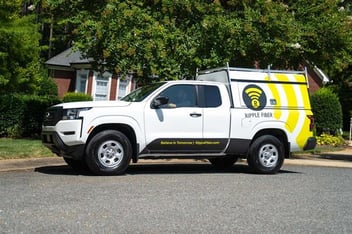
Ripple Fiber launched in 2023 with 13 employees and is now a 10-state operator passing more than 250,000 homes, doubling year on year. What's instructive about their story isn't the growth itself. It's that they encoded their processes into the platform from day one, before the scale arrived. The result is a business that can bring in new contractor crews, stand up new markets, and manage performance across states without proportionally growing the back office. You can read the full story in our Ripple Fiber insight piece. On the field service side, Segra's story makes the same point. Seven years after replacing those Outlook calendars with Field Squared, the company had scaled its operations by 300%. Jim Kent, their Market Vice President of Operations, is direct about the connection: "We've scaled our company up by 300% over seven years, which probably wouldn't have been doable without Field Squared."
For fiber operators, AEX One was built specifically to support that kind of operational model. When an install is completed in the field, it closes back into AEX automatically, triggers provisioning, and starts the billing clock. Workflows, checklists, and documentation requirements are encoded in the platform, and reporting surfaces anomalies before they become patterns. For field service and utility organizations, AEX Field Squared delivers the same outcome on the field operations side. Scheduling, dispatch, workflows, and performance reporting all live in one place, so the informal systems that hold small teams together get replaced by something that actually scales. In both cases the result is the same: growth stops depending on adding people and starts depending on the platform doing its job.
Growth is the goal. The platform is what makes it sustainable.
The operators I've watched scale without breaking aren't doing anything magical. They're making deliberate decisions about operational infrastructure at an earlier stage than feels necessary at the time. They're encoding processes into systems before those systems are under pressure. They're building reporting layers before they need them. And they're closing the gaps between back office and field execution before those gaps compound into something harder to fix.
If your operation is in a growth phase right now, three questions are worth asking. Are your processes in your platform or in your people? Can you see anomalies across every market before they become problems? And when a technician completes an install, does the billing clock start automatically or does something have to happen first?
Those three things will tell you whether you're ahead of the scaling ceiling or heading toward it.
If you'd like to talk through where your operation is heading, schedule a conversation with the AEX team here.
Frequently Asked Question's
What are the most common scaling breakpoints for fiber operators? The most common breakpoints are address data integrity across multiple markets, provisioning lag across different hardware vendors, billing exceptions caused by manual handoffs between field and back-office systems, and customer experience inconsistency as teams grow and disperse across regions.
How do field service organizations lose consistency when they scale? Consistency breaks down when best practices live in people's heads rather than in the platform. Informal knowledge that holds small teams together does not travel across regions, and new technicians or contractors trained by colleagues rather than by a system will execute differently.
What is a manage-by-exception model in field operations? A manage-by-exception model means central functions are consolidated in the platform and anomalies are surfaced automatically, so operations teams focus on resolving exceptions rather than manually monitoring every job across every market.
How does connecting OSS/BSS to field execution reduce scaling friction? When field execution and back-office systems share data in real time, every completed install automatically triggers provisioning and billing without a manual handoff. This removes the most common source of errors and delays in fast-growing fiber operations.
Why should fiber operators treat subscriber acquisition as an operational discipline? A completed fiber build generates no revenue until subscribers are active and billing. Operators who treat subscriber acquisition as an operational system, with pre-orders captured during construction, address-level serviceability data available to all sales channels, and automated lead-to-billing workflows, consistently hit penetration targets faster than those who build the sales operation after the network goes live.