Most fiber operators build a great network and then figure out sales. The construction team has a plan. The engineering team has a plan. The sales operation is whatever someone put together in the weeks before go-live.
That sequence is expensive. A completed fiber build is a depreciating asset until subscribers start paying for it. Every week between network completion and active subscriber is a week of carrying costs with no revenue flowing in. The operators who close that gap fastest are the ones who treated subscriber acquisition as an operational discipline before the first cable went in the ground, not after.
This guide covers what a multi-channel fiber sales operation actually requires, how each channel connects to the others, and how the underlying data infrastructure makes all of it work without manual handoffs between systems.
What Fiber Subscriber Acquisition Actually Involves
Subscriber acquisition for a fiber operator is not a single activity. It is a coordinated set of channels and workflows that capture demand wherever and whenever a potential subscriber is ready to engage, and convert that demand into an active, billing account as efficiently as possible.
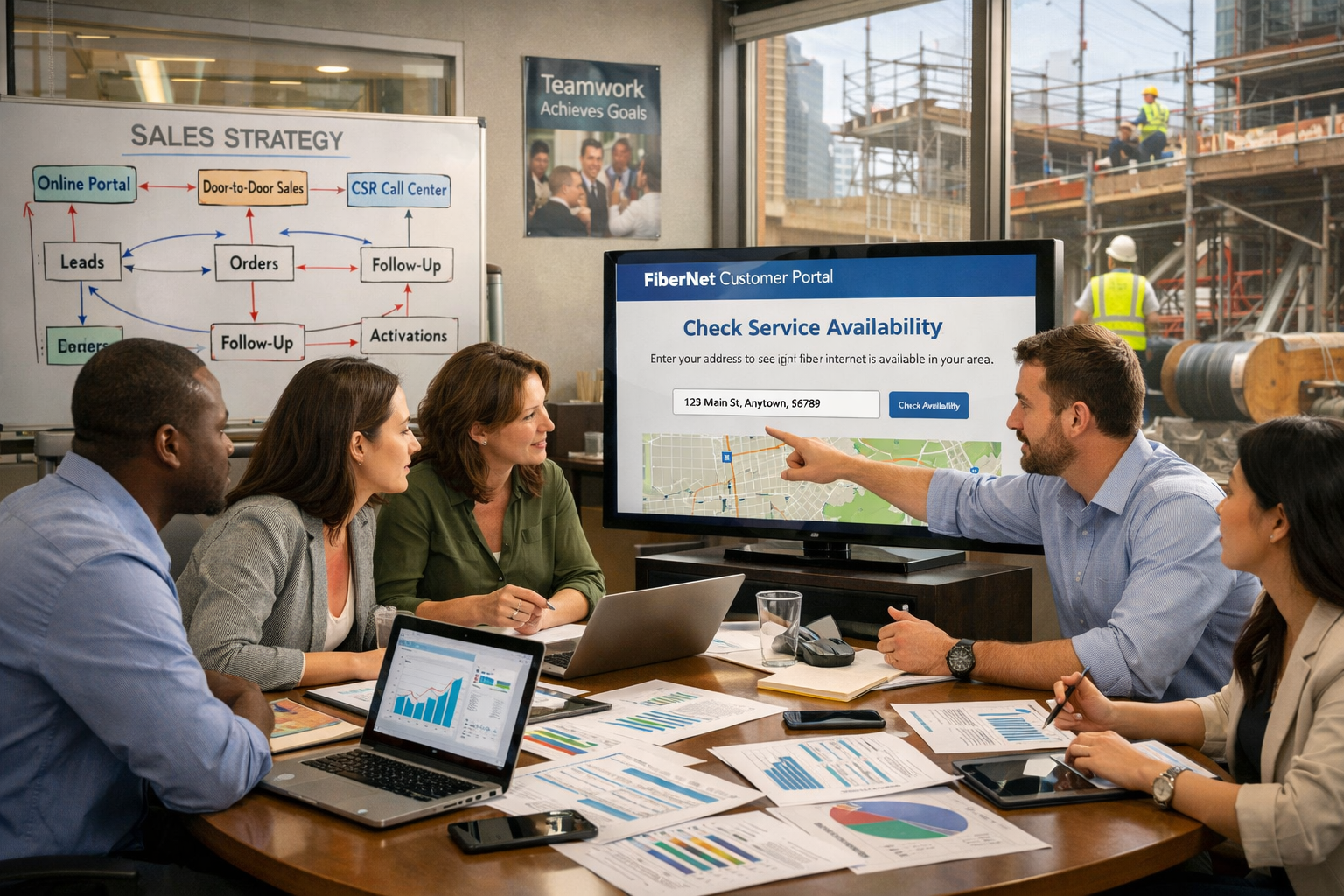
The channels look different from each other but they share the same dependency: accurate, current address-level serviceability data. Without it, every channel breaks down in the same way. An online portal cannot validate whether service is available. A field sales rep cannot tell a resident when to expect service. A CSR cannot quote a product without knowing what the system can actually deliver at that address.
The channels work together when they all read from the same address database and write to the same order management system. When they do not, every handoff between channels creates an opportunity for error, duplicate records, and lost revenue.
The Online Customer Portal
The online portal is typically the highest-volume acquisition channel for a fiber operator. Residents who have seen marketing, heard from a neighbor, or checked a coverage map arrive at the portal ready to find out if service is available and, if it is, to sign up immediately.
What makes a fiber portal effective is not design. It is the address validation layer underneath it. When a resident enters their address, the portal queries the serviceability database in real time and returns one of three responses: service is available now and order entry is open, service is coming soon and pre-orders are being accepted, or the address is outside the planned footprint.
Each response should trigger a different workflow. A serviceable address goes directly to plan selection, payment capture, and scheduling. A pre-build address goes to a pre-order flow that collects service plan preference and payment details and holds the order until the network reaches that address. An out-of-footprint address should capture interest and contact details for future expansion outreach rather than showing a dead end.
The portal should also be deployable as an embeddable form or coverage checker that sits on the operator's marketing website, allowing address validation to happen before a resident even reaches the full portal experience. Every friction point removed between initial interest and completed order improves conversion.
Door-to-Door Field Sales
Door-to-door canvassing remains one of the highest-conversion acquisition channels available to a fiber operator, particularly in greenfield markets where residents have limited awareness of the new provider and benefit from a direct conversation.
The effectiveness of a door-to-door program depends almost entirely on how well the field rep is equipped before they knock. A rep who arrives at a door without knowing whether that address is serviceable, what plans are available, and what the right conversation should be wastes the interaction regardless of how good their pitch is.
A mobile sales app connected to the serviceability database changes that. Before knocking, the rep sees the address status, the available products, and whether the household has any existing lead or pre-order on file. At a live address, they can take a full order including plan selection and payment capture on the spot. At a pre-build address, they have the right conversation about what is coming and when, and they capture a pre-order commitment before leaving the door.
Phone and CSR Order Entry
Inbound phone sales remain a significant channel for fiber operators, particularly for subscribers who prefer to speak to someone before committing, subscribers in older demographics who are less comfortable with online self-service, and prospects who have questions about their specific address or service availability.
A CSR handling an inbound call needs the same address validation capability as the online portal, with the addition of integrated calling tools and a complete view of any existing lead or pre-order history attached to the caller's address. A CSR who has to check serviceability in one system, look up available plans in another, and enter the order in a third is slow, prone to errors, and likely to lose the sale during the handoff.
CSR tools connected to a unified address and order management platform compress that workflow into a single interface. The rep validates the address, selects the plan, captures payment, and confirms the order without leaving the screen. Inbound calls that arrive from pre-build areas can be handled with the same pre-order flow as the online portal, ensuring that no inbound interest goes unconverted regardless of where the caller's address sits in the build timeline.
Lead Management and Pre-Order Pipeline
Not every subscriber acquisition conversation ends in an immediate order. In a greenfield build covering multiple construction phases, a significant portion of your addressable market is pre-build at any given time. Managing that segment well is the difference between a go-live day with hundreds of committed subscribers already in the activation queue and a go-live day that starts from zero.
Lead management for a fiber operator means attaching every expression of interest to a specific property record in the address database. Whether the lead came from the online portal, a door-to-door rep, an inbound call, or a digital marketing campaign, it should resolve to an address-level record that the system can monitor and act on when that address becomes serviceable.
Pre-orders go further. A pre-order captures not just interest but commitment: a service plan selection, a payment method, and an agreement to be activated when service is available. When the network reaches that address and the status updates to serviceable, the pre-order converts to an active order automatically and the downstream scheduling, provisioning, and billing workflows trigger without any manual intervention.
Referral Programs and Digital Marketing
Beyond direct channels, fiber operators have two acquisition levers that compound over time as the subscriber base grows.
Referral programs turn existing subscribers into an acquisition channel. A subscriber who refers a neighbor who signs up generates a lower-cost acquisition than almost any other channel. Built-in referral mechanics, including automated tracking, reward fulfillment, and referral attribution connected to the order management system, allow operators to run referral programs without manual administration.
Targeted digital marketing campaigns become significantly more effective when they are informed by serviceability data. Rather than broadcasting broadly to an entire market, operators who can provide address-level coverage data to their advertising platforms can target residents in specific serviceable or near-live areas with campaigns timed to construction progress. A campaign that goes out to residents in a pocket that just went live outperforms one that goes to a general geographic area where half the addresses cannot yet receive service.
How the Channels Connect
The mistake most operators make is treating each acquisition channel as a separate operation with its own tools, its own data, and its own handoff process to the next stage.
When the online portal, the field sales app, the CSR platform, the lead management system, and the referral program all write to the same order management system and read from the same address database, several things happen that do not happen when they are disconnected.
Duplicate records are eliminated. A resident who visited the portal last week and then spoke to a door-to-door rep today shows up as a known lead in the rep's app rather than a cold contact. A CSR handling an inbound call from a pre-order customer sees the complete history rather than starting from scratch.
Channel attribution becomes clear. You know which channels are converting at which rates, in which areas, at which stages of the build. That visibility informs where to invest sales capacity as construction progresses.
And the handoff from acquisition to activation becomes automatic. An order taken at any channel flows into the same scheduling and provisioning workflow. The subscriber experience from sign-up to active service is consistent regardless of how they came in.
AEX One connects every acquisition channel including online portal, door-to-door mobile sales, CSR order entry, lead management, pre-order queue, referral programs, and targeted campaign data support to a single platform. Every order, regardless of channel, resolves to the same address record, the same serviceability classification, and the same downstream workflow for scheduling, provisioning, and billing. The full operational context for how subscriber acquisition connects to activation and revenue sits in the greenfield fiber network planning guide.
Frequently Asked Questions
What is fiber subscriber acquisition? Fiber subscriber acquisition is the set of sales channels and operational workflows a fiber operator uses to convert potential customers into active, billing subscribers. It spans online self-service portals, door-to-door field sales, inbound CSR order entry, pre-order pipeline management, referral programs, and targeted digital marketing campaigns, all of which depend on accurate address-level serviceability data to function reliably.
What is the most effective channel for acquiring fiber subscribers? The most effective approach combines multiple channels tied to the same underlying address and order data. Online portals capture high-intent prospects who arrive ready to buy. Door-to-door sales convert residents who benefit from a direct conversation. CSR teams handle inbound interest that does not complete online. Pre-order pipelines convert pre-build interest automatically at go-live. No single channel consistently outperforms a coordinated multi-channel approach.
How does a fiber customer portal drive subscriber acquisition? A fiber customer portal drives subscriber acquisition by allowing residents to check serviceability at their specific address and place an order or pre-order immediately based on the result. The portal's address validation layer queries the operator's serviceability database in real time, so every interaction returns an accurate, current status and routes the prospect into the appropriate workflow for their address.
What is a pre-order pipeline in fiber sales? A pre-order pipeline is a structured queue of committed customers in areas where the network is not yet live. Each pre-order captures a service plan selection and payment method tied to a specific address. When construction in that area completes and the address becomes serviceable, the pre-order converts to an active order automatically, triggering installation scheduling and billing without manual intervention.
How do referral programs work for fiber operators? Fiber referral programs incentivize existing subscribers to refer neighbors and contacts who then sign up for service. Effective referral programs are built into the order management platform so that referral attribution, reward tracking, and fulfillment are automated rather than managed manually. As a subscriber base grows, referral programs become an increasingly cost-effective acquisition channel.
How does address-level data improve fiber digital marketing campaigns? Address-level serviceability data allows operators to target digital marketing campaigns precisely to residents in areas where service is available now or coming soon. Rather than broad geographic targeting that includes non-serviceable addresses, campaigns informed by the serviceability database reach the right households at the right moment in the construction timeline, improving conversion rates and reducing wasted ad spend.