
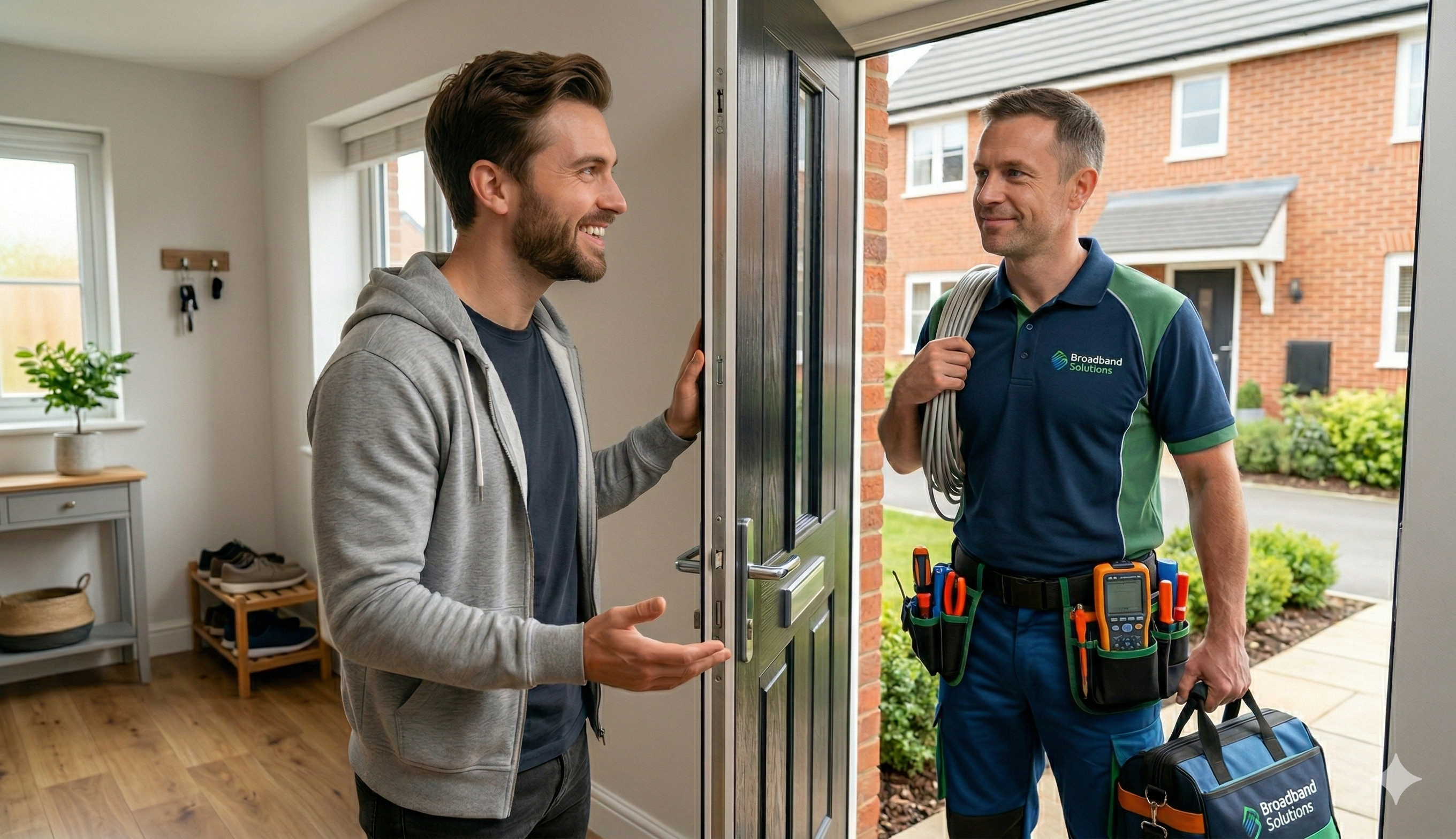
Address errors are quietly one of the most expensive problems in broadband installation. The customer makes a mistake at signup. Nobody catches it until the technician is standing at the wrong front door.
By then, the cost is already locked in. A wasted slot, a wasted drive, a frustrated customer, and an operations team scrambling to reschedule. And the worst part? The customer often does not even realize they caused it. The truck rolled. The technician stood at the wrong address. Somewhere across town, the customer was waiting, wondering why nobody had shown up.
Meet Ben
Ben is the kind of customer every operator wants. Tech-savvy, organized, genuinely excited about upgrading his home network. He signed up for a 2 Gbps fiber package with Lakeview Connect, a growing provider in the Carolinas, the same day the service went live in his neighborhood.
Being the organized type, he downloaded the Lakeview Connect app right after signing up, so he could track the construction progress and get notified when his installation was scheduled. A few days later, the notification came through. He opened it and immediately noticed the problem. The address on the order read 1020 Back Stretch Boulevard. Ben lives at 1002.
One digit. Entered wrong during signup. Easy to do. Very expensive to ignore.
What Would Have Happened Before
Without a self-service option, Ben's path to resolution was a phone call. He would explain the situation, the agent would look up the order, and then the real complexity would begin.
Changing a service address on an existing order is not simple. Depending on the platform, it might mean cancelling the order entirely and creating a new one. That new order would need to go through address qualification again. The scheduled installation slot might not transfer. Ben could end up weeks back in the queue.
Or, if nobody caught it in time, the technician would roll to 1020, find an unoccupied property or a very confused neighbor, and mark the job as unable to complete. Ben would get a call asking him to reschedule. He would have no idea why.
What Actually Happened
Fortunately, Lakeview Connect had AEX Customer Self-Scheduling. Ben tapped the Manage Order button in the push notification. The portal opened directly to his order details. He saw the address field, corrected 1020 to 1002, and hit submit.
The system handled the rest. Behind the scenes, the address change triggered the right workflow: address re-qualification, updated work order routing, and a new scheduling notification sent to Ben once the install was ready to proceed. He did not have to explain anything to anyone. He did not wait on hold. He did not risk losing his place in the queue.
A few days later, the technician arrived at the correct address. Ben was home. Everything worked.
The Operator's Perspective
Lakeview Connect never had to handle that inbound call. The agent's time was never consumed. The bad-address truck roll never happened. The reschedule queue never got touched.
More importantly, the customer never experienced the frustration of a missed install, a confusing callback, or a long wait to get back on the schedule. From Ben's perspective, he spotted a problem and fixed it instantly. That is what a good experience feels like.
Address errors are not rare. They are a predictable, recurring cost of doing business in the broadband industry. Every operator takes orders through multiple channels, and every channel carries some risk of human error at signup. The question is not whether errors will happen. It is whether your customers can fix them before they become expensive.
Self-service address management is not a nice-to-have. For any operator running installs at scale, it is a cost control measure with a very short payback period.
Next in the series: The Last Mile (3 of 3) Ben's neighbor, Frank, had a great experience too. So Ben told Frank to sign up. Then Frank decided to upgrade, and nobody had to sell him anything...
Read the previous post here: The Last Mile (1 of 3): She Almost Missed Her Installation. Instead, She Became a Customer for Life.
FAQ
Q: How much does a "truck roll" cost a broadband provider? A: On average, a wasted truck roll can cost an operator between $150 and $500 depending on labor, fuel, and the opportunity cost of a missed installation slot.
Q: Can customers change their installation address after signing up? A: With AEX Customer Self-Scheduling, customers can update their address details via a mobile app or portal, which automatically triggers re-qualification and updates the work order without agent intervention.
Q: What is the impact of address typos on broadband operations? A: Address typos often lead to "Unable to Complete" (UTC) tasks, frustrated customers, and increased call center volume. Automating the correction process eliminates these bottlenecks.