
Introduction
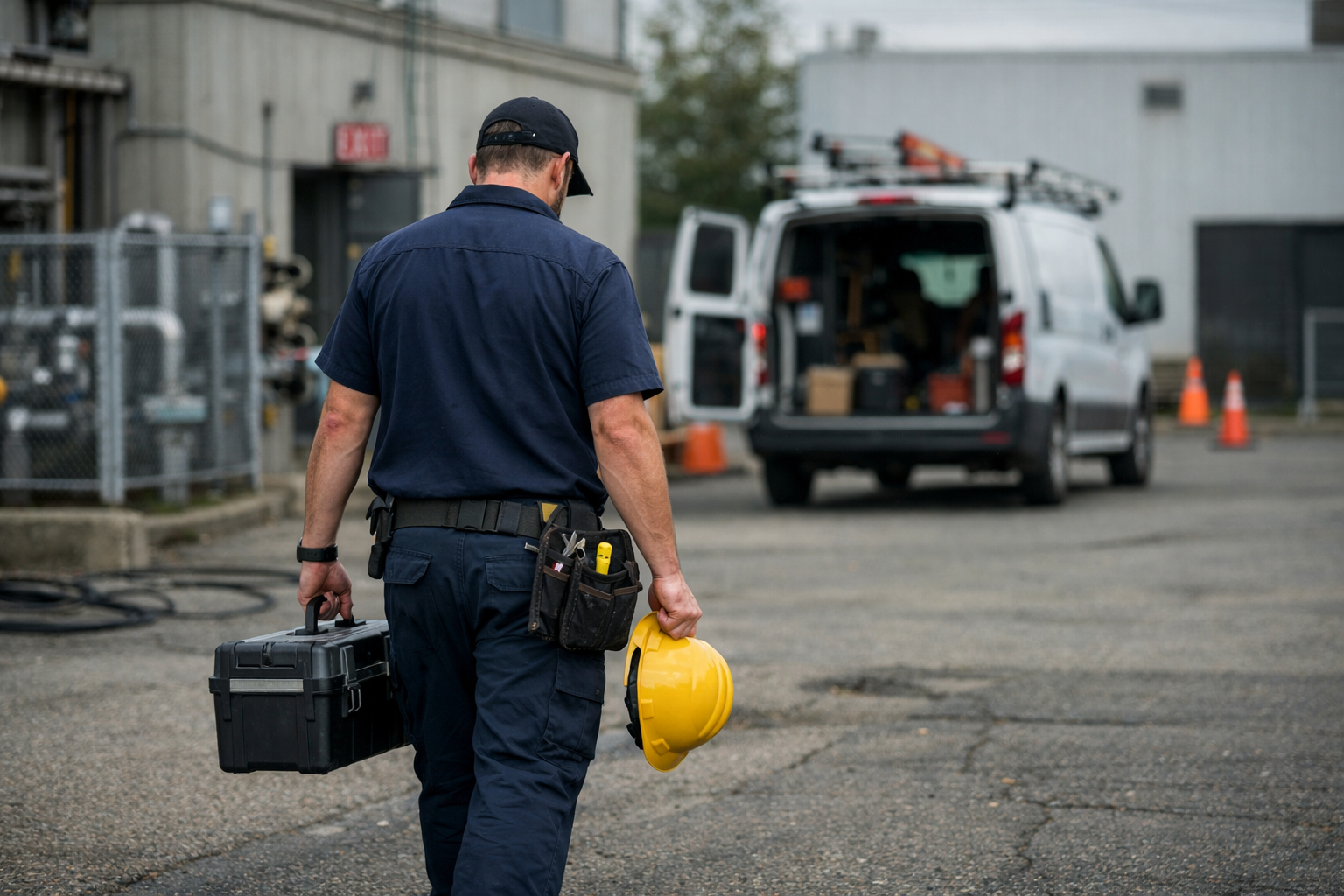
A technician arrives on site, runs the diagnosis, and leaves without completing the job. The part he needs is not on the truck. Or the work requires a certification he does not have. Or the job took longer than the window allowed.
For utilities, telecom operators, and infrastructure service teams, that outcome is not just a customer service problem. It is an operational one.
The repeat visit carries direct costs in labor, travel, and parts handling. It also carries indirect costs in SLA risk, delayed activation, and technician capacity lost to work that should already be closed.
First-time fix rate is the metric that captures how often field service organizations avoid that outcome. It is one of the clearest indicators of whether operations are set up to succeed before a technician ever leaves the depot.
What First-Time Fix Rate Actually Measures
First-time fix rate (FTFR) is the percentage of service requests resolved completely on the first visit, without a follow-up call, repeat dispatch, or return trip for the same issue.
The calculation is straightforward:
FTFR = (Jobs completed on first visit / Total jobs dispatched) x 100
Research by Aberdeen Group puts the industry average FTFR at approximately 75 percent, meaning one in four service calls still requires at least one additional visit. Top-performing organizations, the top 20 percent of the field service industry, consistently achieve rates of 88 percent or higher. That gap represents a significant difference in cost, technician capacity, and operational throughput.
FTFR is closely related to other key field service metrics, including mean time to repair, technician utilization, and repeat visit rate. For a broader view of how these metrics connect, see the field service optimization guide.
Why FTFR Matters Beyond the Obvious
The direct costs of a failed first visit are real. Aberdeen Group research estimates the cost of a single truck dispatch at $200 to $300 per service call depending on the industry and job type. For utilities and telecom operators running hundreds of jobs a day across distributed crews, repeat visits at that cost compound quickly and pull technician capacity away from new work.
The indirect costs are harder to see but equally significant.
Aberdeen's research found that organizations with FTFR above 70 percent average an 86 percent customer retention rate. Those that fall below 70 percent see retention drop by around 10 percentage points. Combined with findings from Bain and Company that a 5 percent increase in retention can lift profits between 25 and 95 percent, the operational case for improving FTFR is clear.
For fiber and telecom operators specifically, a failed installation visit delays activation, which delays billing. A single day of delay per installation, multiplied across hundreds of jobs during a build phase, has a direct and measurable impact on revenue timing. The relationship between field execution and billing speed is covered in depth in From Interest to Install to Invoice.
What Drives Low First-Time Fix Rates
Low FTFR rarely has a single cause. It is usually the result of several operational gaps that each contribute to a technician arriving without what they need to complete the job.
Aberdeen Group identified the three leading causes of repeat visits as insufficient or incorrect parts on site (51 percent of cases), the technician lacking the correct training or experience for the job (25 percent), and insufficient time allocated to complete the work (13 percent).
| Root Cause | What It Looks Like | Operational Impact |
|---|---|---|
| Wrong technician assigned | Job requires certifications or equipment experience the assigned tech does not have | Repeat visit with correct technician |
| Parts not on the truck | Required component not confirmed or staged before dispatch | Job deferred until parts arrive |
| Incomplete job information | Technician arrives without site access details, equipment specs, or service history | Time lost on site, job incomplete |
| Poor pre-job qualification | Work scope not fully assessed before dispatch | Technician encounters conditions they cannot resolve |
| No real-time support access | Technician cannot reach technical documentation or back-office support from the field | Extended on-site time or failed completion |
| Scheduling without skill matching | Job assigned based on availability alone | Technician competent but not qualified for this job type |
Three of these causes deserve closer attention because they account for the majority of repeat visits and are the ones most directly addressable through operational and technology changes.
Parts availability is the single largest driver of low FTFR at 51 percent of cases. The problem is not usually that parts do not exist. It is that no one confirmed they were on the truck or staged at the site before the technician left. In infrastructure and telecom operations, where jobs may require specific ONTs, splitters, or cable grades, a generic inventory check is not enough. Parts confirmation needs to be tied to the specific work order. Tracking parts accurately at the job level is one of the core functions covered in the field service management metrics guide.
Skills mismatches account for one in four repeat visits. In field service organizations that dispatch based on availability rather than capability, this is a structural problem. A technician who is qualified for standard maintenance may not be certified for a specific equipment vendor or job type. Without visibility into technician profiles at the dispatch stage, those mismatches only surface on site.
Insufficient time allocation is often treated as a scheduling problem but it is frequently a data problem. When job time estimates are based on averages rather than job-specific complexity, technicians are set up to run over. Sites that were qualified poorly, jobs with unusual access requirements, or equipment that requires longer configuration times all affect how long a job actually takes. Better pre-job data produces better time estimates and reduces the number of jobs that cannot be completed within the assigned window.
Most organizations with FTFR below 70 percent have two or more of these issues operating simultaneously. Fixing one without addressing the others produces limited improvement.
How to Increase First-Time Fix Rates
Match technicians to jobs based on skills, not just availability
Skills-based dispatching is one of the highest-impact changes a field service operation can make. When job assignments are driven by technician certifications, equipment experience, and job-type history, the right person arrives for the right job more consistently.
For utilities managing planned maintenance windows or telecom operators dispatching crews across multiple build zones, this is especially important. A missed skill match does not just cost a repeat visit. It can delay interconnected work and push downstream jobs off schedule.
This requires accurate technician profiles in the scheduling system and dispatch logic that factors skills into assignment decisions. Given that wrong technician assignment accounts for a quarter of all repeat visits, skills-based routing addresses one of the most common and most preventable causes of low FTFR. The AEX Field Squared field service management platform supports skills-based assignment as part of its core dispatch workflow, matching job requirements to technician profiles before a job is ever confirmed.
Improve parts availability before the job starts
Technicians who arrive without the right parts cannot complete the job. The solution is not to carry more inventory on every truck. It is to understand what a specific job requires before dispatch and confirm those parts are available.
Integrated inventory management, connected to work order data, allows dispatchers and technicians to verify parts availability before a job is assigned. When a required part is missing, the job can be rescheduled or parts staged in advance rather than discovered as a problem on site. For infrastructure operators managing ONTs, cable runs, and network equipment across large build programs, this kind of pre-job inventory confirmation is a direct lever on both FTFR and activation timelines.
Give technicians complete job context before arrival
Incomplete job information is a leading cause of extended site time and failed completions. Technicians need site access details, equipment history, previous service notes, and any location-specific requirements before they arrive.
Mobile workforce management platforms that deliver full job context to field devices, including offline access for areas with poor connectivity, reduce the time technicians spend gathering information on site and increase the likelihood of completing the job in a single visit. For crews working in rural or underserved areas during fiber build programs, offline capability is not optional.
Use pre-job qualification to reduce scope surprises
Not every service request is what it appears to be at intake. A brief qualification step, either through structured intake questions or a pre-visit check, reduces the chance that a technician arrives to find conditions significantly different from what was described.
For fiber installations, pre-qualification can confirm site readiness, access availability, and equipment compatibility before the visit is scheduled. Site conditions in greenfield builds often vary from what planning data shows, and catching that variance before dispatch saves a truck roll.
Provide real-time support access from the field
Even experienced technicians encounter situations that require escalation. When field workers can access technical documentation, reach back-office support, or consult diagnostic information from their mobile device, they can resolve more issues without returning to base.
Platforms that support real-time collaboration between field technicians and operations teams extend the effective capability of the workforce without adding headcount. For lean field teams managing large build programs, that matters.
The Role of Technology in Sustained FTFR Improvement
Individual process changes produce improvement. Sustained improvement at scale requires technology that connects scheduling, inventory, job information, and field execution into a single operational workflow.
Field service management platforms address FTFR at the point where it is actually determined, before the technician leaves, not after the repeat visit is logged.
Skills-based dispatch engines match job requirements against technician certification profiles automatically, removing the guesswork from assignment decisions. When a job requires a specific equipment vendor certification or a particular skill type, the system surfaces qualified technicians rather than leaving that judgment to a dispatcher working across dozens of open jobs simultaneously.
Integrated inventory management connects parts availability to individual work orders. When a job is created, the platform checks whether the required components are available and flags gaps before dispatch. Technicians arrive knowing the job is set up to be completed rather than discovering problems on site.
Mobile workforce platforms deliver full job context to field devices before the technician arrives. Equipment history, site access instructions, configuration requirements, and previous service notes are all available offline as well as online. For field teams operating in areas with inconsistent connectivity, that offline capability is the difference between a technician who can proceed and one who has to call back to the office.
Real-time field updates close the loop between execution and operations. When a technician completes a step, encounters an issue, or needs support, that information is visible to the operations team immediately. Escalations happen in real time rather than after the fact. Completion data flows back into the system as the job progresses, not after the technician drives away.
When these capabilities operate together, each job dispatched is better prepared than the last. FTFR improvement becomes a function of operational design rather than individual technician performance.
The TSIA State of Field Services 2025 report identifies operational efficiency and technology adoption as the two defining priorities for field service leaders this year, with FTFR improvement sitting at the intersection of both.
Closing Perspective
First-time fix rate is a lagging indicator. By the time it shows up in reporting, the decisions that determined it were already made in scheduling, dispatch, inventory, and job setup.
Organizations that improve FTFR consistently do so by working on those upstream decisions, not by tracking the metric more closely. Skills-based assignment, pre-job parts confirmation, complete job context, and real-time field support each address a specific cause of repeat visits.
Taken together, they build field operations that complete more work on the first attempt, reduce cost per job, and move faster from installation to activation to revenue.
Frequently Asked Questions
What is a good first-time fix rate for field service?The industry average sits at approximately 75 percent according to Aberdeen Group research. Top-performing organizations, the top 20 percent of field service businesses, reach 88 percent or higher. The right target depends on service complexity, technician specialization, and job type mix.
What causes low first-time fix rates?Aberdeen Group identifies the three leading causes as insufficient or incorrect parts on site (51 percent), technicians lacking the required skills or training for the job (25 percent), and insufficient time allocated to complete the work (13 percent).
How does skills-based dispatching improve FTFR?Skills-based dispatching ensures the technician assigned to a job has the specific certifications, equipment knowledge, and job-type experience required. When job assignments match technician capability, completion rates on the first visit increase. Wrong technician assignment accounts for roughly one in four repeat visits.
How does inventory management connect to first-time fix rates?Insufficient or incorrect parts are the single most common cause of repeat visits, accounting for over half of all cases. Integrated inventory management connected to work order data allows organizations to confirm parts availability before dispatch and stage materials in advance when needed.
Does first-time fix rate apply to fiber installation operations?Yes. For fiber and telecom operators, FTFR applies directly to installations. A failed installation visit delays activation and billing. Pre-job qualification, skills-based dispatch, and complete job information are particularly important in installation contexts where site conditions vary from planning data.
How do I track first-time fix rate accurately?FTFR requires a work order system that records job outcomes and flags return visits for the same issue or address. Field service management platforms with integrated reporting track FTFR alongside related metrics such as repeat visit rate and technician utilization.
External Sources:- Aberdeen Group First-Time Fix Rate Research: https://www.concerttech.com/wp-content/uploads/2021/03/Aberdeen-Group-RR-First-Time-Field.pdf
- Bain and Company customer retention research: https://www.bain.com/insights/retaining-customers-is-the-real-challenge/
- TSIA State of Field Services 2025: https://www.tsia.com/blog/state-of-field-services-2025