
An OSS/BSS platform connects order to cash by unifying the operational and business systems that move a customer from initial order through to paid invoice. For fiber and broadband operators, this means linking provisioning, field dispatch, activation, and billing into a single workflow. AEX Software builds this connection into a unified platform that eliminates the handoffs where revenue typically leaks.
This article explains what OSS and BSS mean in plain terms, how they work together in the order-to-cash flow, and why midsize operators benefit from a unified approach. You will also learn decision criteria for evaluating platforms and how automation reduces the delays that slow revenue.
Key Takeaways: How an OSS BSS Platform Connects Order to Cash
- OSS manages network operations like provisioning and activation, while BSS handles billing, orders, and customer data.
- Disconnected systems create handoff points where orders stall, activations delay, and billing starts late.
- A unified OSS/BSS platform automates the workflow from order capture through provisioning to first invoice.
- AEX Software connects field execution, zero-touch provisioning, and billing triggers into one operational flow.
- Midsize operators gain the most from platforms that scale without requiring enterprise-level IT resources.
What Are OSS and BSS in Broadband Operations?
OSS stands for Operations Support Systems. These are the technical systems that manage your network infrastructure, including service provisioning, activation, fault detection, and performance monitoring. When a technician activates a customer's ONT at the premise, the OSS handles the configuration.
BSS stands for Business Support Systems. These are the commercial systems that manage customer-facing activities like order capture, billing, and revenue tracking. When you generate an invoice or process a payment, you're working in the BSS layer.
Together, OSS and BSS cover the full operational lifecycle. The TM Forum maintains widely referenced standards for how these systems interact. For fiber operators, getting these two layers to communicate cleanly is what determines how fast you move from serviceable address to paying subscriber.
How Does the Order-to-Cash Workflow Actually Function?
The order-to-cash workflow is the end-to-end process that starts when a customer places an order and ends when you collect payment. Each step depends on the one before it. A breakdown at any point creates downstream delays.
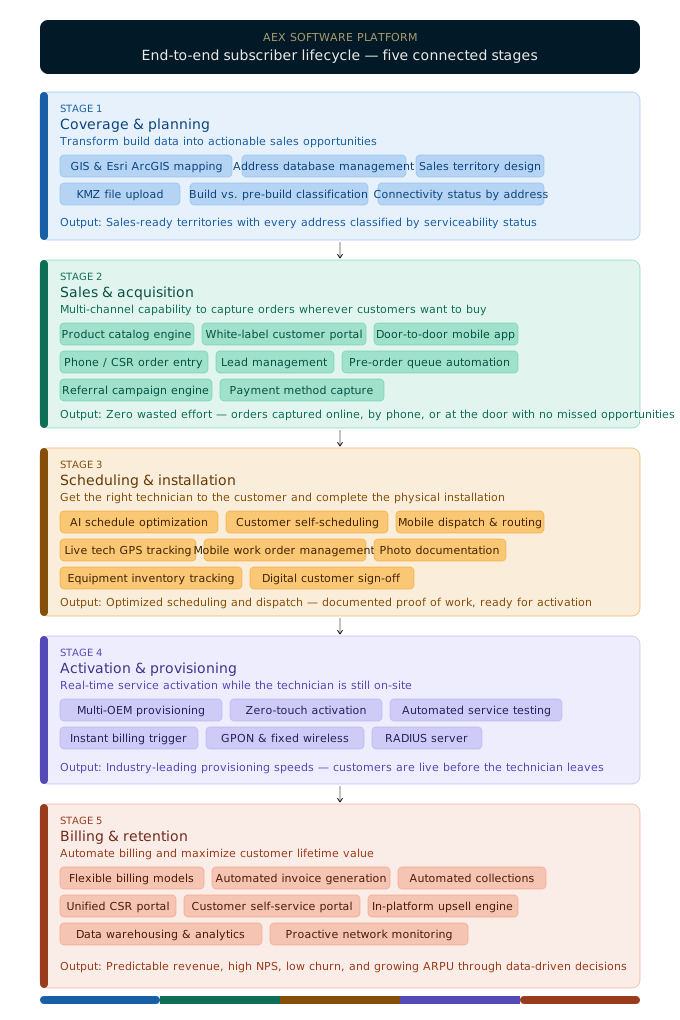
The sequence typically follows these stages: order capture validates the customer and their service address. Dispatch assigns the installation job to a field technician. On-site installation connects the physical equipment. Provisioning configures the device and authenticates it against your network. Activation confirms the service is live. Billing generates the first invoice.
When these stages live in separate systems, data has to move between them manually or through fragile integrations. That's where errors enter. An order gets captured but dispatch doesn't receive it for hours. A technician completes the install but provisioning runs separately the next day. The customer is live but billing doesn't start until someone manually updates the account.
Where Revenue Leakage Happens in the Order-to-Cash Cycle
Revenue leakage occurs when services are delivered but not billed correctly or on time. The most common leakage points happen at system boundaries. A service activates in the network but the billing system doesn't receive the activation trigger. A promotional rate expires but the system doesn't update the charge. A technician marks a job complete but the data doesn't sync to billing.
According to industry research, fiber operators running disconnected systems routinely lose revenue to these gaps. The fix isn't better reporting after the fact. The fix is connecting the systems so billing triggers automatically when service goes live.
What Does a Unified OSS/BSS Platform Do Differently?
A unified OSS/BSS platform connects provisioning, dispatch, and billing into one data environment. When a customer order enters the system, it flows through qualification, scheduling, field execution, activation, and billing without crossing system boundaries.
This means fewer handoffs. Fewer handoffs mean fewer places where data gets lost, delayed, or corrupted. The technician completes the install, the provisioning runs automatically, and billing starts the same day. AEX Software delivers this through a platform that connects field service management, zero-touch provisioning, and automated billing triggers into one workflow.
For midsize operators running multi-state networks, this architecture matters. You get enterprise-level automation without the deployment timelines or IT overhead that traditional enterprise platforms require. You can learn more about how this works in the AEX One platform overview.
How Does Zero-Touch Provisioning Accelerate Activation?
Zero-touch provisioning eliminates the manual step between physical installation and service activation. Instead of waiting for a remote team to configure the device after the technician leaves, the configuration triggers automatically while the technician is still on-site.
The process works like this: the technician completes the physical install and connects the ONT. The provisioning platform detects the device, matches it to the service order, and pushes the configuration automatically. RADIUS authentication validates the device credentials. The system runs a bandwidth test to confirm performance. If everything passes, the service goes live and billing starts immediately.
The entire sequence takes minutes. The technician confirms activation before leaving the property, which eliminates return visits for provisioning-related issues. AEX Software supports hardware-agnostic provisioning across major OEMs including Calix, Adtran, Nokia, and Ciena.
Why Do Fragmented Systems Create Delays and Billing Errors?
When your order management, dispatch, provisioning, and billing systems don't share data in real time, you create dependency chains that slow everything down. An order sits in a queue waiting for someone to manually transfer it to dispatch. A completed install waits for a separate provisioning ticket to be processed. Billing waits until someone confirms activation.
Each wait adds hours or days to your order-to-cash cycle. At scale, those delays compound into significant revenue deferral. If your average activation delay is three days across 500 monthly installs, that's 1,500 subscriber-days of billing delay every month.
The operational cost is also real. Truck rolls for provisioning-related return visits typically cost between $150 and $300 when you include labor, fuel, and scheduling overhead. An operator with a 15 percent return visit rate on 500 monthly installs absorbs the cost of 75 unnecessary truck rolls every month.
What Should Midsize Operators Look for in a Platform?
Midsize operators face a specific challenge. Enterprise OSS/BSS platforms are built for carriers with large IT departments and multi-year deployment budgets. Lightweight tools work at startup but hit limits as subscriber counts grow and network complexity increases.
When evaluating platforms, focus on these criteria. First, does the platform unify OSS and BSS functions or does it require separate integrations? Second, does it support hardware-agnostic provisioning across multiple OEMs? Third, can billing triggers fire automatically from activation events? Fourth, does it include field service management or require a separate dispatch system?
Also consider deployment timelines. A platform that takes a year to configure creates a year of continued inefficiency. Look for platforms designed for operators at your scale that can go live in months rather than years.
How Does Field Dispatch Connect to Provisioning and Billing?
Field dispatch is the link between your back office and your technicians. When dispatch, provisioning, and billing operate as separate systems, the field team works in isolation. They complete the install, but the data about what they did doesn't flow automatically to the systems that need it.
In a connected workflow, the technician's mobile device captures installation data, triggers provisioning, confirms activation, and closes the work order in one sequence. The same data that confirms job completion also starts the billing cycle. There's no separate data entry, no waiting for sync, and no gap where information gets lost.
This connection is what enables same-day billing. The moment the technician leaves a live installation, the customer's first invoice period begins. AEX Software connects AI-powered scheduling and dispatch to provisioning and billing through the same platform, which eliminates the data gaps that cause billing delays.
In Summary: Connecting Order to Cash With a Unified Platform
The order-to-cash workflow determines how fast you turn serviceable addresses into revenue. Disconnected systems create handoff delays, provisioning errors, and billing gaps that slow that conversion and leak revenue.
A unified OSS/BSS platform eliminates those gaps by connecting order capture, field dispatch, provisioning, activation, and billing into one data flow. For midsize fiber and broadband operators, this architecture delivers enterprise-level automation at a scale that fits your operations and your budget.
The operators who shorten their order-to-cash cycle gain a compounding advantage. They bill sooner, reduce truck rolls, and deliver a better customer experience from the first interaction.
FAQs About How an OSS BSS Platform Connects Order to Cash
What is the difference between OSS and BSS?
OSS (Operations Support Systems) manages network-side functions like provisioning, activation, and fault detection. BSS (Business Support Systems) manages customer-facing functions like billing, order management, and revenue tracking.
Together, they cover the full operational and commercial lifecycle of a broadband service. A unified platform connects both so data flows automatically between them.
What does order-to-cash mean for fiber operators?
Order-to-cash is the end-to-end process from when a customer places an order to when you collect payment. For fiber operators, this includes order capture, service qualification, dispatch, installation, provisioning, activation, and billing.
AEX Software shortens this cycle by connecting each step into one automated workflow, which reduces delays and starts billing faster.
How does zero-touch provisioning reduce truck rolls?
Zero-touch provisioning activates service automatically while the technician is still on-site. This eliminates return visits caused by provisioning failures or delays that occur when activation runs separately from installation.
AEX Software's zero-touch provisioning supports multiple OEMs, so your technicians can activate any vendor's device in minutes without waiting for remote configuration.
Why do disconnected systems cause revenue leakage?
When provisioning and billing operate in separate systems, activation events don't automatically trigger invoicing. Services go live but billing starts late, or not at all. Promotional rates expire but charges don't update.
A unified OSS/BSS platform eliminates these gaps by connecting activation directly to billing triggers.
What should midsize operators prioritize in OSS/BSS selection?
Focus on platforms that unify OSS and BSS functions, support hardware-agnostic provisioning, include field service management, and can deploy in months rather than years.
AEX Software helps midsize operators get enterprise-level automation without the deployment timelines or IT overhead that traditional enterprise platforms require.


