
Why lifecycle automation matters now
Network operators are under pressure across every stage of service delivery.
• Faster build schedules
• Rising subscriber expectations
• Tighter funding and compliance requirements
• Leaner operations teams
At the same time, many operators still rely on OSS, BSS, and field service systems that operate independently. Each handoff between systems introduces delay, cost, and operational risk.
Full lifecycle service automation brings these workflows together into a single operational flow. Platforms such as AEX One are designed to maintain service continuity across planning, orchestration, field execution, activation, and billing.
For modern broadband and infrastructure operators, this approach is becoming foundational rather than optional.
What full lifecycle service automation actually means
Full lifecycle service automation is the ability to manage a service from first intent through long term operations without losing context or data ownership.
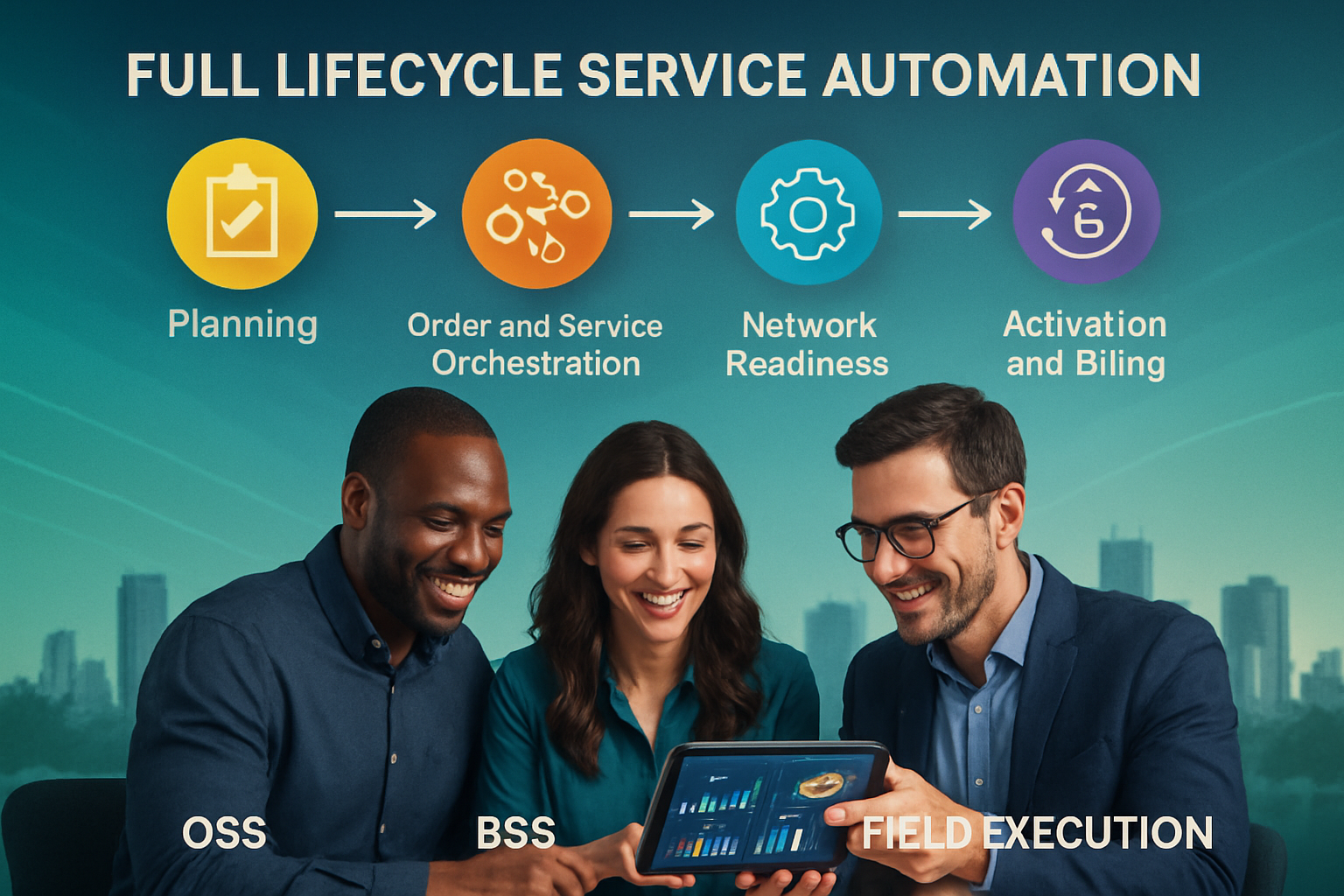
It connects five core phases.
• Planning and service qualification
• Order and service orchestration
• Network readiness and provisioning
• Field execution and verification
• Activation, billing, and ongoing lifecycle management
Instead of each phase living in a separate system, automation keeps service state consistent across OSS, BSS, and field execution.
This is the difference between basic integration and true operational continuity.
The operational cost of fragmented lifecycle systems
Fragmentation rarely shows up as a single failure. It shows up as small gaps that compound as networks scale.
A service is qualified in one system. Work is completed in another. Activation waits on manual checks. Billing lags behind what actually happened in the field.
Over time, those gaps create real operational drag. Teams spend time reconciling systems instead of moving work forward. Field crews complete jobs that take days or weeks to convert into live services. Customer-facing teams lack confidence in service status because no single system reflects the full picture.
These are not edge cases. They are structural issues created when OSS, BSS, and field execution operate independently.
Industry research reinforces what operators experience day to day. McKinsey’s research on telecom technology performance shows that operators with stronger digital and automation foundations consistently outperform peers on execution and cost efficiency because they reduce manual handoffs and system fragmentation.
McKinsey has also highlighted how AI-driven automation in telco service operations is becoming essential as service and field operations make up a significant share of operating costs, leaving little room for inefficiency as networks grow.
From an architectural perspective, Gartner’s Market Guide for CSP Service Design and Orchestration identifies lifecycle orchestration as a core capability for communications service providers modernizing OSS and BSS environments, emphasizing visibility that spans network, business, and field operations.
Taken together, the message is clear. Fragmentation is not just an IT problem. It is a lifecycle problem that directly affects speed, cost, and service quality.
How lifecycle automation works in practice
Lifecycle automation begins with a single service record that persists from planning through activation.
• Qualification informs scheduling and provisioning
• Field execution updates service readiness as work is completed
• Verified completion triggers activation conditions
• Billing reflects what was actually delivered
By tying field execution directly to service lifecycle state, reconciliation delays between systems are removed and the time between completion and revenue is reduced.
The result is
• Faster time to revenue
• Fewer revisits and truck rolls
• Higher first time install quality
• Stronger audit trails for compliance and funding
OSS, BSS, and field execution working together
Lifecycle automation only works when OSS, BSS, and field execution share service state.
• OSS provides network and service intelligence
• BSS manages customer orders and lifecycle status
• Field systems capture ground truth
AEX supports this orchestration across different deployment models, whether operators are launching new networks or modernizing existing ones.
For new builds, lifecycle automation helps greenfield operators establish operational workflows quickly while maintaining control from day one.
For expansion and overbuild scenarios, brownfield operators rely on lifecycle continuity to introduce new services without disrupting existing operations.
For mature networks, established fiber providers depend on automation to align execution, activation, and billing across complex environments.
Why operators are prioritizing lifecycle automation now
Several forces are converging across the industry.
• Large scale broadband and fiber deployments
• Funding programs requiring verifiable proof of work
• Customer expectations shaped by real time digital services
• Ongoing labor constraints in the field
Lifecycle automation reduces risk by ensuring every stage of service delivery is visible, verifiable, and connected.
What to look for in a lifecycle automation platform
When evaluating lifecycle automation capabilities, operators should look for:
• A unified service data model across OSS, BSS, and field systems
• Event driven automation rather than batch updates
• Field captured proof of work tied directly to service records
• API driven extensibility without brittle custom integrations
• Clear visibility from order through activation
Without shared service state, automation remains partial.
For network operators, lifecycle automation is not about adding more systems or forcing teams to work differently. It is about identifying where service delivery loses continuity today and reconnecting planning, execution, and activation around a shared service model. As networks scale, that continuity becomes the foundation for faster revenue, clearer visibility, and more predictable service outcomes. The questions below address some of the most common points operators consider when evaluating this approach.
Frequently asked questions
What is full lifecycle service automation
Full lifecycle service automation is the ability to manage a service end to end using one continuous workflow across OSS, BSS, and field execution systems, ensuring service state remains consistent from qualification through activation and ongoing operations.
How is lifecycle automation different from integration
Integration connects systems, while lifecycle automation aligns service state so every system operates from the same source of truth throughout the service lifecycle.
Why is lifecycle automation important for network operators
Lifecycle automation reduces delays between field completion and activation, improves operational visibility, and helps operators scale service delivery without increasing manual effort or operational risk.
Christopher James Camut is President of AEX Software and former CEO of Field Squared.
Sources
McKinsey Transforming Telecom Tech
Explores how digital and automation maturity impacts execution and cost efficiency for telecom operators.
https://www.mckinsey.com/industries/technology-media-and-telecommunications/our-insights/transforming-telecom-tech-how-it-excellence-drives-innovation-and-cost-efficiency
McKinsey AI in Telco Service Operations
Covers the growing role of automation and AI in service and field operations as networks scale.
https://www.mckinsey.com/industries/technology-media-and-telecommunications/our-insights/how-ai-is-helping-revolutionize-telco-service-operations
Gartner Market Guide for CSP Service Design and Orchestration Solutions
Outlines service design and orchestration as a core capability for communications service providers modernizing OSS and BSS environments.
https://www.gartner.com/reviews/market/csp-service-design-and-orchestration-solutions